AI in paid media is not new. Most PPC teams have already spent years working with automation, broad match, Performance Max, smart bidding and AI-generated assets.
But the shift coming out of Google Marketing Live 2026 feels different.
The promise is no longer just better campaign management. The bigger change is that Google is moving from AI that assists users to agents that can complete more of the journey on their behalf. In practice, that means search, discovery, comparison, product questions, cart building and checkout are becoming more connected.
In this article, I’ll break down the updates I think matter most for PPC and commerce teams, where I’d be cautious, and what brands should prioritise now if they want to stay visible, measurable and commercially ready.
Search is moving from keywords to conversations
For years, search marketing has been built around one fairly simple behaviour: a user types a query, Google returns a set of results, and advertisers compete to appear in the right place at the right time.
That model is not disappearing overnight. But it is becoming less complete.
At Google Marketing Live, one of the clearest messages was that the consumer interface has changed. Google’s own GML EMEA highlights framed the shift as a move from keyword-led search to a “full-scale conversational ecosystem,” with AI Overviews reaching 2.5 billion monthly users and AI Mode scaling to 1 billion monthly users. They also noted that users are asking questions that are three times longer than before, with brainstorming queries growing 30% faster than standard searches.
That matters because longer, more conversational searches are not always neat bottom-funnel queries. They often happen earlier in the decision-making process.
A shopper may not search for “best running shoes size 8.” They may ask, “What running shoes should I buy if I’m training for my first half marathon and get knee pain after 5k?”
That is a very different kind of signal.
For PPC teams, this means we need to think beyond matching a keyword to an ad. We need to think about whether our campaigns, landing pages, feeds and product data can give Google enough context to understand when our products are genuinely relevant.
Search agents raise the bar for usefulness
The next layer is agents.
Google described Search Agents as autonomous assistants that can run in the background, monitor the web, manage complex tasks, track niche product drops, find hard-to-book appointments and even place calls to local businesses on a user’s behalf. These agents are expected to start rolling out to Google AI Pro in summer 2026.
This is where the search experience starts to feel less like a results page and more like delegated decision-making.
For brands, that raises a practical question: if an agent is doing the legwork for the user, what information will it trust?
My view is that the fundamentals become more important, not less. Product data needs to be accurate. Stock levels need to be reliable. Pricing needs to be current. Returns information, delivery timelines, sizing, reviews and product attributes all need to be easy for machines to understand.
This is not just an SEO concern or a feed management concern. It’s a performance marketing concern because these are the inputs that will increasingly influence whether a brand is visible in AI-led journeys.
AI Max is where PPC teams need to pay attention now
AI Max is one of the most immediate updates for paid media teams.
Google’s own announcement for AI Max for Search describes it as a suite of targeting and creative enhancements designed to help advertisers expand into new relevant queries while retaining controls and reporting transparency. Google has also said advertisers activating AI Max in Search campaigns typically see 14% more conversions or conversion value at a similar CPA or ROAS, rising to 27% for campaigns that are still mostly using exact and phrase keywords.
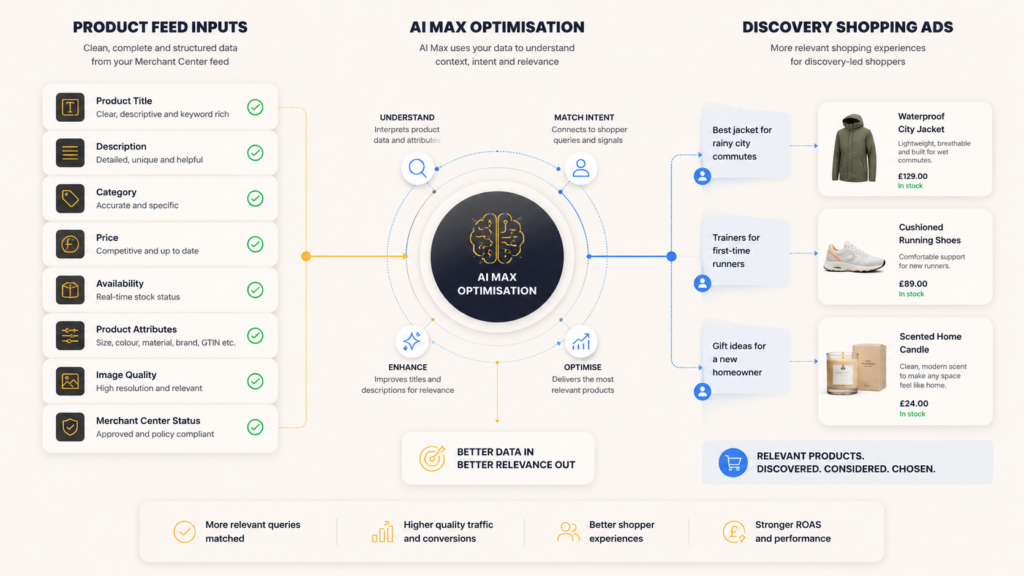
Google also highlighted AI Max for Shopping, which extends AI Max into product feeds by tailoring ad titles and descriptions to match what a shopper is actually looking for. The important bit for retailers is that this is designed to reach shoppers at the discovery stage, before they necessarily know which product they want.
That is powerful. It also creates a dependency.
If product feeds are thin, inconsistent or poorly structured, AI Max has less useful information to work with. If your Merchant Center setup is clean, with detailed attributes, strong titles, accurate availability and clear product categorisation, you are giving the system a much better foundation.
This is why one of the immediate follow-ups from the training was a dedicated Merchant Center session for the team. That is the right priority. Before we ask AI to do more, we need to make sure the inputs are as good as they can be.
AI Brief is useful, but it’s not a replacement for strategy
AI Brief was another interesting update.
The idea is simple: instead of manually managing lots of keywords and copy variations, advertisers can describe their brand, product and goals, then let Gemini use that brief to steer ad copy and targeting. Google’s GML EMEA highlights describe AI Brief as a way to guide how AI generates ad copy and reaches the right customers.
I can see the appeal. Anyone who has managed large-scale PPC accounts knows how much time can go into building, refining and testing copy.
But this is also where I would be cautious. I’m sceptical about how accurate this would be, at least in the short term, compared with proper manual management. That scepticism is not anti-AI. It’s quality control.
A good PPC strategy is not just a collection of keywords and ads. It includes commercial priorities, margin considerations, stock issues, promotional calendars, brand positioning, customer value and competitive pressure. A tool can help produce and scale variations, but the brief still needs to come from people who understand the business.
So, I would use AI Brief as a support tool, not a strategy tool. Let it help with speed. Don’t let it decide what matters.
Business Agents could change customer service and conversion journeys
Business Agents are one of the more interesting commerce updates because they sit directly inside the shopping experience.
At GML, Google described describes Business Agents as a chat feature on a brand profile, allowing customers to interact with a business without leaving the search results. The agent can use information from the website and Google Merchant Center to answer complex customer questions, including queries around stock, sizing and product quality. It can also be customised for brand tone of voice and made available 24/7.
For retailers, this could be genuinely useful.
A lot of conversion friction comes from unanswered questions. Does this fit small? Is it in stock in this colour? When will it arrive? Is it suitable for a particular use case? If those questions can be answered inside the search experience, brands may be able to reduce friction before the user even lands on site.
But again, the risk is quality of data.
A Business Agent can only be as useful as the information it can access. If the website content is weak, the Merchant Center feed is incomplete, or product information is inconsistent, the experience will not feel helpful. It may even create more confusion.
This is why commerce readiness matters. The front-end AI experience gets the attention, but the back-end data does the work.
Universal Cart is the clearest sign that purchase journeys are being compressed
Universal Cart is where the shift becomes very real for commerce brands.
Universal Cart will allow users to add items to a cart while browsing Search, chatting with Gemini or watching YouTube. Once an item is added, the cart can monitor price drops and stock levels in the background. It can also connect with Google Wallet to understand payment perks and loyalty information, then support checkout through Google Pay or transfer the user to the brand’s site.
That is a major change because it compresses the path from discovery to purchase.
From a user perspective, it’s convenient. From an advertiser perspective, it raises some important questions.
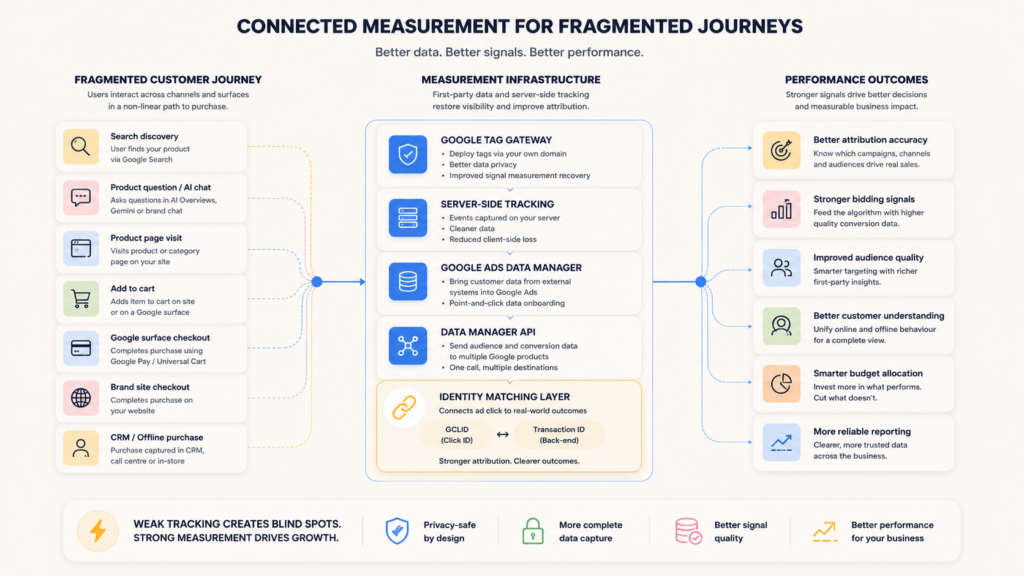
Where does the conversion happen? How do we attribute it? How much control does the brand have over the experience? What happens to remarketing audiences if fewer users visit the site before purchasing? How do we measure performance when discovery, cart building and checkout are spread across Google surfaces?
I don’t think the answer is to panic. The answer is to prepare.
Brands should be looking at Merchant Center quality, payment readiness, loyalty data, product attributes and measurement infrastructure now. Waiting until these journeys are mainstream will make the work harder.
Creative scaling is useful, but brand judgement still matters
The creative updates are impressive.
Gemini Omni was presented as a model capable of creating high-quality video from text, images, video and audio inputs. GML also highlighted conversational editing, where users can describe the changes they want and the AI handles the edit.
Gemini Flow then acts as a creative hub across video, image and music, with the ability to brainstorm dialogue, map out story beats, organise assets and keep characters, voices and visual styles consistent because it runs on Gemini Omni.
There are several practical retail use cases. For example, a brand could create or adapt shoot assets without needing to travel to a specific location, or adjust creative details like lighting and movement after the fact.
That has obvious efficiency benefits.
But creative efficiency is not the same as creative effectiveness. Faster asset production is only valuable if the assets are still relevant, distinctive and commercially useful.
The brands that benefit most will not be the ones that create the most assets. They will be the ones that use AI to test better ideas, localise creative faster, respond to trading moments and remove production bottlenecks without losing brand control.
Measurement is the part I would prioritise first
Of all the updates, the measurement conversation may be the most important.
If users can discover products, ask questions, add items to a cart and complete purchases without following the traditional path through a website, measurement needs to evolve with the journey.
Internally, our focus has shifted to server-side tracking, Google Tag Gateway and the Data Manager API. We’ve identified these as key solutions for future-proofing measurement, particularly where GCLID IDs from paid ads need to be linked with back-end transaction IDs to attribute sales correctly.
Google describes Google Tag Gateway for advertisers as a way to deploy the Google tag using your own domain, improving data privacy and signal measurement recovery. Google Ads Data Manager is described as a point-and-click tool for bringing customer data from outside Google into Google Ads, while the Data Manager API allows audience and conversion data to be sent to multiple Google advertising products with a single call.
The commercial point is simple: if the buying journey becomes more fragmented, weak tracking becomes a bigger problem.
Better first-party data will not just help reporting. It will help bidding, audience quality, customer understanding and budget allocation. In an AI-led media environment, signal quality is a performance lever.
So, what should brands do now?
The temptation with any Google Marketing Live update is to chase every new feature.
I would take a more practical route.
First, audit your Merchant Center setup. Make sure product titles, descriptions, categories, availability, pricing, GTINs, imagery and attributes are as complete and accurate as possible. AI Max for Shopping, Business Agents and Universal Cart all depend on product data quality in different ways.
Second, review your measurement setup. If your business still relies heavily on browser-side tracking alone, it’s worth exploring Google Tag Gateway, server-side tagging and stronger first-party data connections.
Third, treat creative AI as a workflow advantage, not a replacement for creative thinking. Use it to increase testing velocity, adapt assets and reduce production friction, but keep strategy, quality control and brand judgement close.
Fourth, keep human oversight in your PPC process. Tools like AI Brief may help with speed, but they still need experienced people setting the direction, checking the outputs and connecting campaign activity back to business goals.
The real shift is control through better inputs
The agentic commerce era can sound abstract. But for advertisers, the practical takeaway is very clear.
Yes, we’ll have less control over every individual step of the user journey. But we can also gain influence by improving the quality of the inputs that AI systems use to make decisions.
That means better product feeds. Better first-party data. Better measurement. Better creative systems. Better commercial context. Better alignment between PPC, SEO, data, tech and commerce teams.
The future of PPC is not just campaign management inside Google Ads. It’s the discipline of making a business easier for AI systems to understand, recommend and measure.
That’s where the opportunity is now. And it’s where I would focus first.

Divya Patel
Associate PPC Director
Divya Patel is Associate PPC Director at Glass Atlas, where she leads the PPC department and helps ecommerce brands solve complex performance challenges. With almost 13 years’ experience across PPC and paid social, Divya has worked agency-side across a wide range of sectors, with a particular focus on ecommerce. Her work combines technical paid media expertise with a strong understanding of product data, automation and commercial performance.