
Browser restrictions, consent requirements and fragmented technology are weakening the data behind marketing decisions. Here’s how to decide whether server-side GTM, Google Tag Gateway or a simpler fix will give you more reliable tracking.
Digital teams are being asked to make better decisions from tracking that’s increasingly incomplete. Server-side GTM and Google Tag Gateway can improve the quality, control and resilience of your data, but only when each is used for the right job.
If you’re responsible for digital performance, you’ve probably felt that tension already. Leadership wants more confidence in attribution and media efficiency, while browsers, consent requirements and fragmented technology make reliable measurement harder.
Thankfully, there are solutions at hand to make your life easier. In this article, I’ll explain what server-side Google Tag Manager (or sGTM), and Google Tag Gateway actually do, how they work together, where the business case is strongest and which common claims you should treat with caution.
WHY TRACKING QUALITY IS BECOMING A BUSINESS PROBLEM
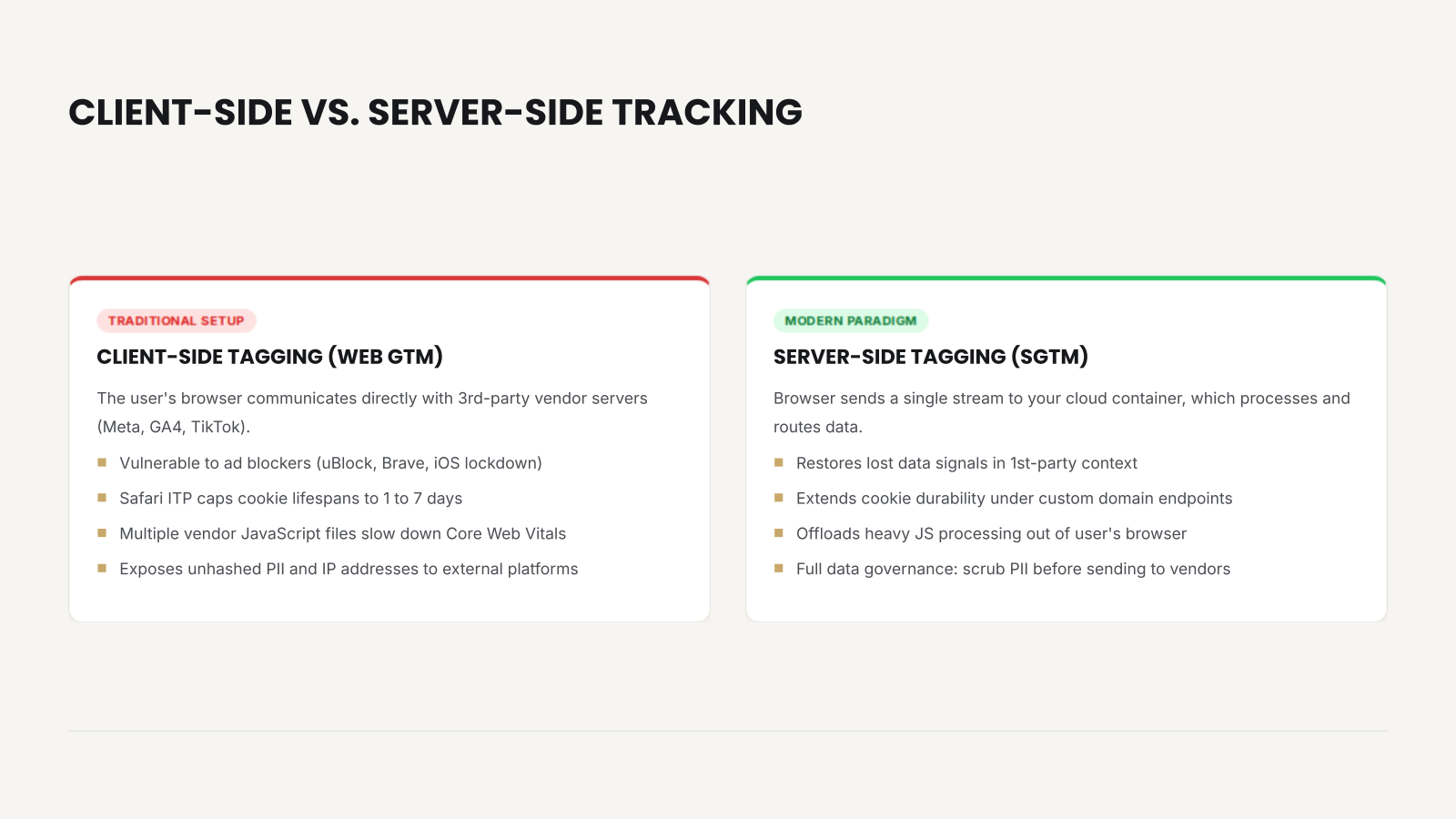
Traditional client-side tagging asks a customer’s browser to load scripts and communicate directly with platforms such as Google, Meta and TikTok.
While that remains useful, it creates several points of failure. Scripts may be blocked, cookie lifespans may be restricted, and every additional third-party tag can add network and processing overhead.
For marketing leaders, the consequence isn’t simply a messier analytics report. Missing or inconsistent signals can affect attribution, audience creation and the information available to automated bidding systems. At the same time, poorly governed tag estates can create unnecessary performance and privacy risk.
The maturity gap is significant. Google has reported that 90% of marketers consider first-party data important, but only one in three believe they use it effectively.
The opportunity isn’t to collect everything. It’s to build a cleaner, consent-aware flow of useful data that supports better decisions.
WHAT DOES SERVER-SIDE GTM ACTUALLY CHANGE?
With sGTM, a server container sits between the customer’s browser and the vendors receiving measurement data. The browser still records the initial interaction, but data can then be validated, transformed, enriched or removed before it is routed onwards.
That distinction matters. Server-side tracking isn’t a replacement for your web container, your consent management platform or a well-designed data layer. It is a controlled processing layer.
One thing I see regularly with clients is the assumption that buying server-side infrastructure will fix an inconsistent implementation. It will not. If purchase values, product identifiers or consent states are wrong when they enter the pipeline, moving the pipeline doesn’t make them right. The first step is still an audit of the data layer, event definitions and consent logic.
When the foundations are sound, the benefits can be meaningful:
- Fewer direct browser-to-vendor requests can reduce third-party code and processing overhead (Source: Google)
- A controlled server endpoint lets teams validate payloads, remove or hash sensitive fields and decide what each vendor receives (Source: Google)
- First-party serving can provide more durable measurement than a default third-party endpoint, subject to browser behaviour and correct configuration (Source: Google Devs)
Cleaner and more complete signals can improve reporting and give advertising platforms better inputs for optimisation. The size of that improvement must be measured against your own baseline.
HOW THE DATA MOVES
The simplest way to understand sGTM is as a governed routing layer.
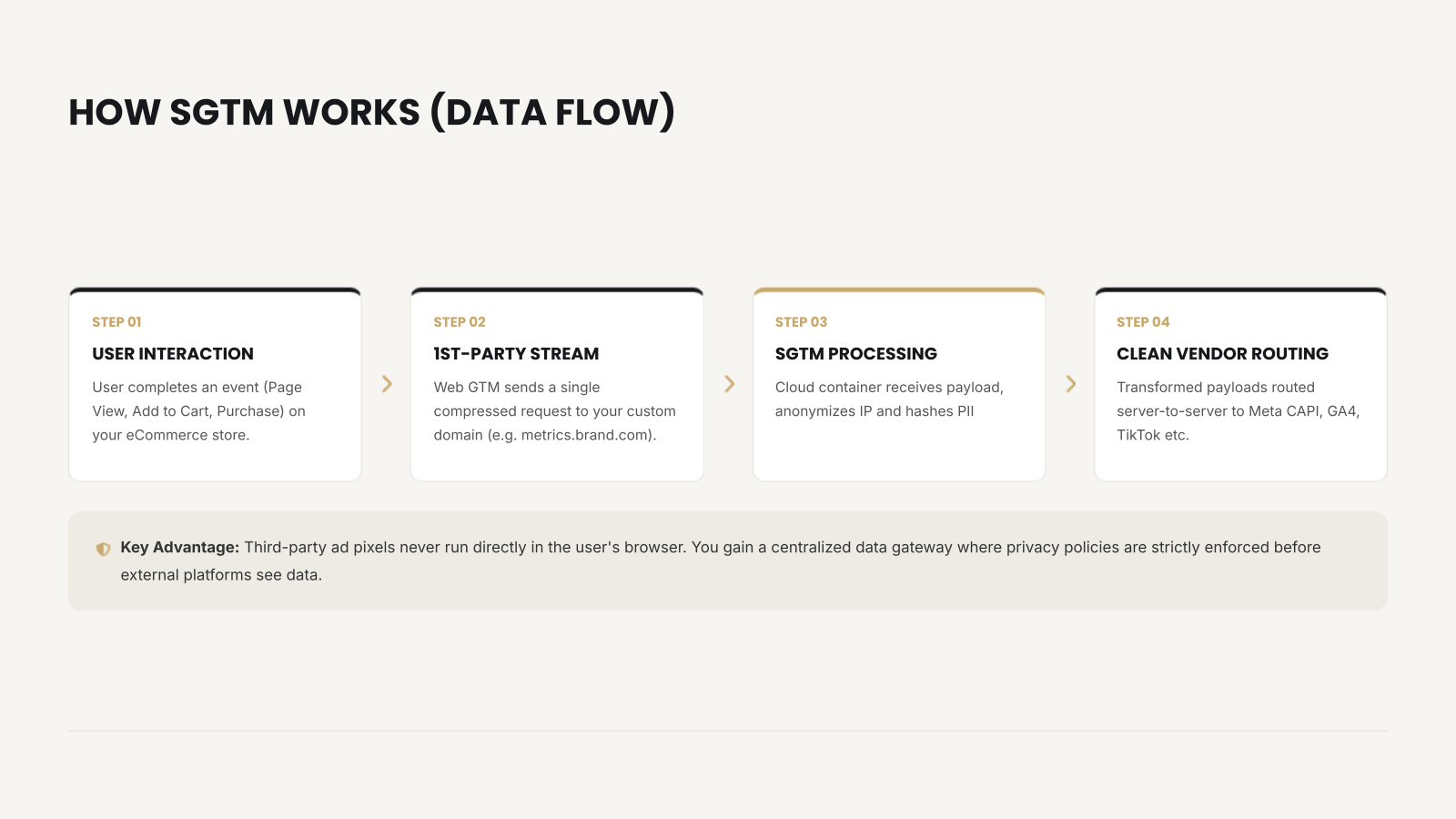
A user completes an event, such as viewing a product or making a purchase. Web GTM sends the event to a first-party endpoint. The server container processes the payload according to your rules. Clean, permitted data is then routed to the relevant platforms.
This creates a central point where data quality and privacy policies can be applied consistently. It can also reduce the number of vendors with which the browser communicates directly. It doesn’t remove the need for consent. The ICO’s guidance makes clear that cookies, tracking pixels, scripts and tags remain within the scope of storage and access rules.
WHAT GOOGLE TAG GATEWAY DOES DIFFERENTLY
Google Tag Gateway tackles a narrower problem. It allows Google tags to be served through your own domain and first-party infrastructure, rather than loading them from a recognisable Google domain. Google supports deployment through a CDN, load balancer, web server or server-side tagging setup.
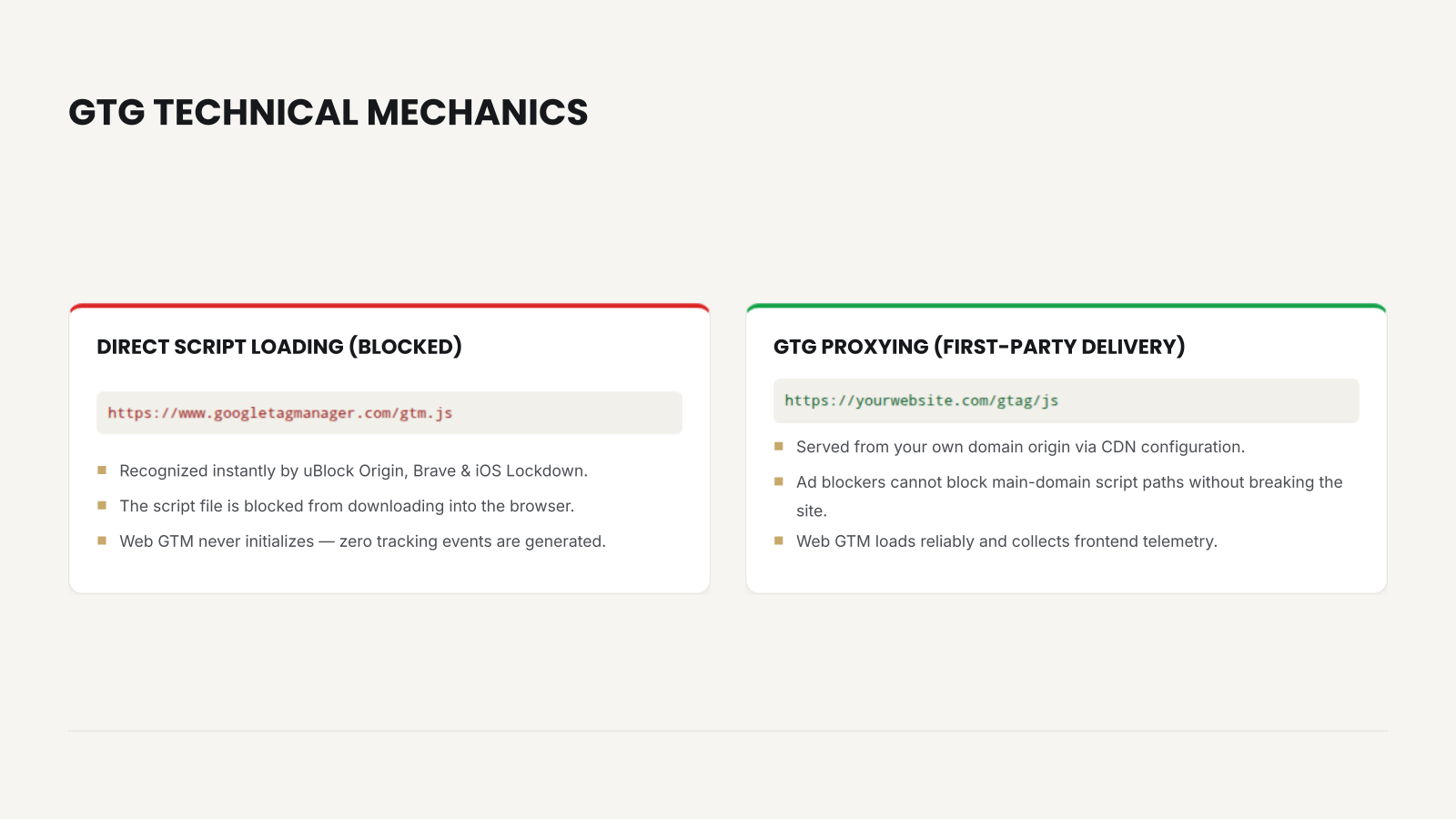
This can make Google tag delivery more resilient and reduce third-party interactions. It isn’t a general data transformation layer, and it doesn’t replace sGTM for routing data to vendors such as Meta or TikTok. Google’s own recommended architecture combines CDN-based Tag Gateway with sGTM when an organisation needs both durable first-party script delivery and controlled data processing.
GOOGLE TAG GATEWAY COMPARED WITH SERVER-SIDE GTM
| Feature | Google Tag Gateway | Server-side GTM |
|---|---|---|
| Primary purpose | First-party Google script serving and loading | Data processing, transformation, enrichment and routing |
| Vendor scope | Google tags, including GA4 and Google Ads | Multiple vendors, including Google, Meta, TikTok and Klaviyo |
| Hosting and cost | Uses existing supported infrastructure; no separate Google Gateway fee | Requires cloud or managed server infrastructure |
| PII and enrichment | Not a general transformation layer | Can validate, remove, hash or enrich fields before routing |
WHEN IS THE FULL SETUP WORTH THE INVESTMENT?
Let’s face it: cost matters.
I would prioritise the full stack where paid media is commercially significant, reporting gaps are affecting decisions, the site has a mature consent setup, and the business can maintain the infrastructure properly.
Google Tag Gateway itself does not require a separate Google fee, but sGTM needs cloud or managed hosting, which varies depending on traffic and provider. Treat that as a planning estimate, not a universal price.
One thing I see regularly with clients is a tendency to compare that cost with zero. While I understand why, it’s a misguided approach: the better comparison is with the value of the media and decisions the data supports. If a business spends heavily across Google, Meta and TikTok, a modest improvement in signal quality may be valuable. If traffic and paid investment are limited, a simpler native integration may be more proportionate.
Platform architecture also changes the answer. Shopify businesses may already use native or specialist solutions such as the Google and YouTube app, Elevar or EasyTag. BigCommerce implementations can require more development where the available data layer doesn’t expose the events and attributes needed.
Start with the platform, current integrations and data gaps, then design the solution.
FREQUENTLY ASKED QUESTIONS
Do Web GTM and sGTM duplicate code on the website?
No. Web GTM continues to collect browser events. The server container runs in cloud infrastructure and processes requests sent to it, so it doesn’t add a second copy of the same container code to the page.
Do I need to update my Content Security Policy?
Potentially. A first-party endpoint can reduce the number of third-party domains the browser needs to contact, but your existing directives, custom domain and vendor routes still need technical review. Don’t treat sGTM as separate from the rest of your security architecture.
Should I use Cloudflare for Google Tag Gateway?
If Cloudflare is already your CDN, it may provide a practical route for configuring first-party Google tag delivery. Google documents CDN deployment options, including Cloudflare. The right choice depends on how your domains, proxying and existing security rules are configured.
Can native ecommerce integrations replace sGTM?
Sometimes they can cover enough of the requirement. The question isn’t whether the integration is labelled “server-side”, but whether it captures the events you need, respects consent, exposes useful diagnostics and supports every required destination. Test those capabilities before adding more infrastructure.
How should we prove the business case?
Proving a strong business case starts with establishing a baseline first. Compare event volumes with backend transactions, inspect duplicate and missing events, review match quality in ad platforms, measure page performance, and document the time spent reconciling reports.
After implementation, repeat the same checks. The outcome should be judged through improved decision confidence, operational efficiency and marketing performance, not a generic recovery promise.
BETTER TRACKING STARTS WITH PROCESS, NOT TECHNOLOGY
sGTM and Google Tag Gateway can make measurement more resilient, controlled and useful. They can’t compensate for unclear event definitions, broken consent logic or a weak data layer.
That may lead to Google Tag Gateway, sGTM, a native platform integration or a combination of all three. The right answer is the one that improves data quality while remaining compliant, maintainable and proportionate to the decisions it supports.
Think that server-side Google Tag Manager could help solve your data challenges? Get in touch with a member of our team today.

Ollie Lees
Data Strategy Director
Ollie Lees is the Data & Analytics Director at Glass Atlas. He has extensive experience across ecommerce strategy and measurement, with a background spanning PPC, CRO, SEO, affiliate marketing and email. Having previously held senior insight and strategy roles at Space 48 and Bring Digital, he now helps brands improve how they collect, govern and use data to make clearer commercial decisions.