An invisible product isn’t necessarily one an AI shopping assistant can’t find.
Sometimes, it can find the product perfectly well. It just can’t work out why it should recommend it.
You can see the difference in the way people are starting to research purchases. A shopper may not search for a specific mattress brand, size or price. They might ask:
“My husband snores and it’s disrupting my sleep. Can you recommend a mattress and sleeping environment that might help?”
That isn’t really a product search. It’s a request for specialist advice.
The shopper has a need, but they may not know the brand, the product or even the exact category they should be looking in. One detailed prompt can take them through research, comparison and towards a purchase much faster than a sequence of traditional searches.
If your products never appear in that process, they don’t enter the consideration set.
That’s what an invisible product looks like in practice.
AI product visibility has a double lock
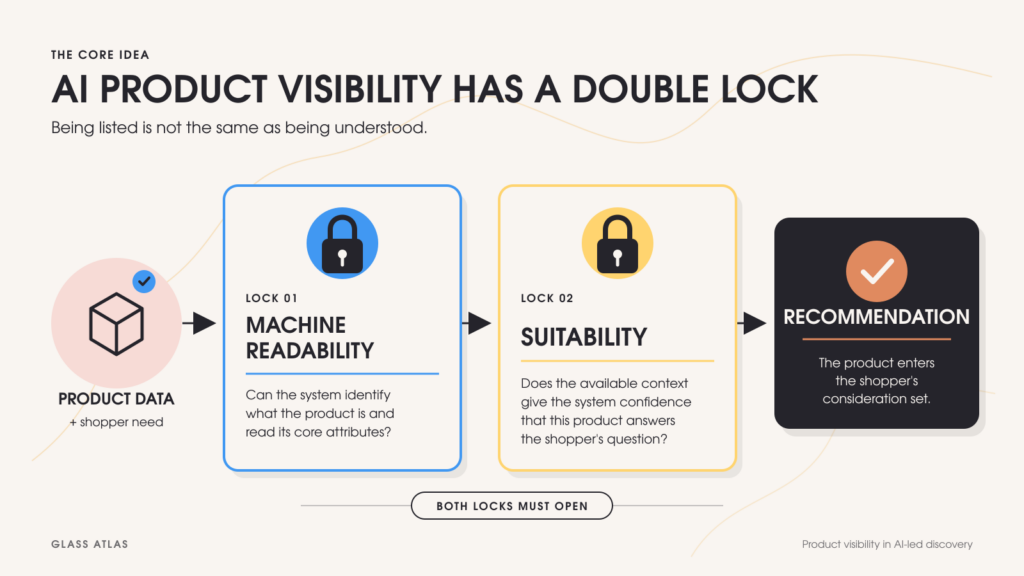
My view is that product visibility now has a double lock.
The first lock is machine readability. Can the LLM establish that your business sells a product that’s broadly relevant to the shopper’s request?
The second is suitability. Does the information available give an AI agent enough confidence that this particular product answers the consumer requirements nestled within question being asked?
Retailers need to open both.
The first part is familiar. Your product data needs to be accessible, accurate and structured consistently. Google explicitly warns that missing or inaccurate information can lead to limited eligibility, incorrect product displays or disapprovals in Merchant Center. Its product data specification covers identifiers, descriptions, imagery, availability, shipping and other attributes.
But completing the fields isn’t the same as providing a real, valuable answer to your potential buyers.
AI-led discovery is moving beyond lists. People are asking for advice, recommendations and explanations. The product therefore needs enough context to match a much more specific need.
That’s the second lock.
A factually complete feed can still be a weak answer
For a long time, retailers have quite reasonably focused on putting as much factual product information as possible into their websites and feeds.
That’s still important. But facts on their own don’t always explain why a product is useful.
Take a crude example. “Two-metre handle” and “three-prong head” describe a garden tool. “Extended handle to reduce bending” and “three-prong head for greater soil aeration” start to explain what those features do for the customer.
The underlying facts haven’t changed. The second version simply gives a system more information with which to connect the product to a need.
Google’s current direction makes this increasingly clear. It now documents optional conversational attributes, including product questions and answers, related products and supporting document links. These are specifically intended to help AI agents understand product nuances.
I think retailers should take the hint.
Don’t abandon factual product data or start filling descriptions with unprovable benefit claims. Instead, connect accurate features contained within the product page and feeds to advertising platforms, to genuine use cases, customer questions and practical benefits.
Where product catalogues commonly break down
Across large retail catalogues, we repeatedly see two versions of the same problem.
The first is an empty field. A retailer may decide that an attribute doesn’t feel relevant because there’s only one shipping method, one image or one available configuration.
The second is almost as limiting: the field has technically been completed, but the answer is so basic that it adds very little to an AI’s understanding of the product.
You need to tell Google everything useful you can about the product.
Think of the feed as a recipe. Having all the ingredients matters, but so does the quality of what you put in. A short, generic description doesn’t become useful simply because it sits in the correct column.
For a retailer with tens of thousands of products, these missed opportunities compound quickly. They can limit eligibility, weaken relevance and make it harder for products to surface against commercially valuable questions.
You can check out Productcaster’s 13-attribute framework here.
CASE STUDY: Putting Productcaster to the test
Bigvits ran a four-week trial to compare Productcaster directly with Google’s own CSS. The retailer recorded a 32% improvement in impressions, a 15% swing in clicks and a 13% cost saving. Read the Bigvits case study.
First things first: measure where you’re visible
If I were responsible for a large retail catalogue, I wouldn’t begin by rewriting thousands of product descriptions.
First things first, I’d establish where the brand appears now.
A new group of specialist platforms can monitor how businesses, products and competitors appear across AI-generated answers. At Productcaster, we’re currently working with Searchable, while platforms such as Evertune and Semrush are also developing capabilities in this area.
The exact choice of tool is less important than creating a usable baseline.
That baseline should show:
- whether your brand or products appear for important customer questions
- which competitors appear instead
- whether you’re merely mentioned or actively recommended
- which websites, publications or other sources are being referenced
- where visibility changes by product category, prompt or AI platform
You can’t meaningfully improve AI visibility if you don’t know how you’re performing today.
More importantly, I don’t think this work should be added to the side of an SEO or paid media team’s existing reporting deck. AI visibility needs to be treated as a distinct channel outcome, with its own baseline, questions and measurement.
That doesn’t necessarily mean creating another isolated team. In fact, isolation would create a different problem.
AI visibility is the sum of several channels
An emerging AI-visibility model sits across four areas that most retailers already invest in:
- organic search and website content
- paid and organic social content
- digital PR
- affiliates, creators and other trusted authorities
Organic search supplies product pages, advice and structured website content.
Social platforms supply demonstrations, video, imagery and customer-facing explanations.
Digital PR creates references from publications and other authoritative sources. Affiliates and creators add independent product comparisons, opinions and recommendations, even when some of those relationships are commercial.
We should be careful about pretending we know exactly how every AI platform weights every source. We don’t. Different systems will use different combinations of sources and retrieval methods.
But the broad principle is useful. AI visibility isn’t produced by one optimisation in one channel.
Most retailers are already doing these activities. The real question is whether the teams responsible for them are working towards a shared set of customer questions and visibility priorities.
Bringing those channels together allows the sum of the parts to do more.
EXPLORE THE SERIES: AI visibility is just one part of the shift towards agentic commerce. Sign up for the Navigating the First Agentic Peak webinar series to explore what’s next for AI-led discovery and purchasing and receive the webinar white paper when the series concludes.
Multimodal discovery changes the role of product imagery
I think people are underestimating multimodal search.
Consumers can now express what they want using combinations of text, voice and images. Google describes AI Mode as being designed for exactly this kind of multimodal interaction, including questions submitted through text, a microphone or a camera.
Imagine taking a photograph of an anorak and asking where you can buy something similar. Or photographing your car and asking which polish is suitable. Or asking where to buy the wire spool for a very specific model of garden strimmer (that may or may not be from my own recent experience…)

For visually led purchases, a conventional product image may not provide enough context.
We explored this through work on a door category for a DIY retailer. The project combined deeper feed optimisation with the generation of lifestyle imagery. The aim wasn’t simply to populate more fields. It was to help show how individual products could look within different environments.
A feed can tell a system that a door is ornate, painted green and designed for a period property. A lifestyle image can show that door against a rose-pink wall in a finished room.
For someone asking which colours, finishes or styles work together, the image may answer part of the question more effectively than a conventional description.
AI-generated assets make it possible to represent more of those situations without organising thousands of individual product photoshoots. In other words, brands can use AI to create richer assets that help other AI systems understand and recommend their products.
That’s the twin-track opportunity here. Consumers are using AI to ask deeper questions, while retailers can use AI to create some of the information and assets needed to answer them.
I wouldn’t pretend that one image treatment explains an entire commercial result. The more useful lesson is that product data and product assets should be treated as one connected system.
Where I would start
Retailers don’t need to rebuild every product page at once. I’d start with one commercially important category and work through five steps.
- Establish a visibility baseline. Identify the real questions customers ask and track which brands and products appear.
- Audit feed completeness and quality. Find empty attributes, vague descriptions, inconsistent identifiers and weak imagery.
- Connect features to genuine benefits. Explain what the product helps the customer do, while keeping every claim accurate and supportable.
- Bring your channels together. Give organic, social, digital PR and affiliate teams a shared set of customer needs and priority prompts.
- Test richer visual contexts. Choose a category where appearance, compatibility or setting matters, then measure whether better assets improve visibility and commercial performance.
Start narrowly enough to learn something.
If you take on an entire catalogue before establishing a baseline or hypothesis, you may produce thousands of new descriptions and images without knowing whether any of them changed how the products were understood.
The distinction I’d leave retailers with is simple.
Being listed isn’t the same as being understood.
AI can only recommend a product when it can both identify what the product is and understand why it fits the question. If you want your catalogue to enter the consideration set, you need to open both locks.
Explore more from Productcaster
Want to go deeper into AI-led product discovery? Sign up to Productcaster and Summit’s webinar series for practical insights from experts at Google, Awin, Summit and Productcaster.

Martin Corcoran
CEO, Summit & Productcaster
Martin Corcoran, CEO of Summit and Productcaster, has dedicated his career to driving success in retail and e-commerce. From his early days at Dunnhumby to leading Summit since 2016, Martin’s passion lies in helping retailers stand out. By combining smart strategies with innovative technology like Productcaster, he ensures clients win customer loyalty and achieve real results. Known for his hands-on approach, Martin is committed to spending clients’ money as carefully as his own, delivering value and measurable impact every step of the way.